.png)
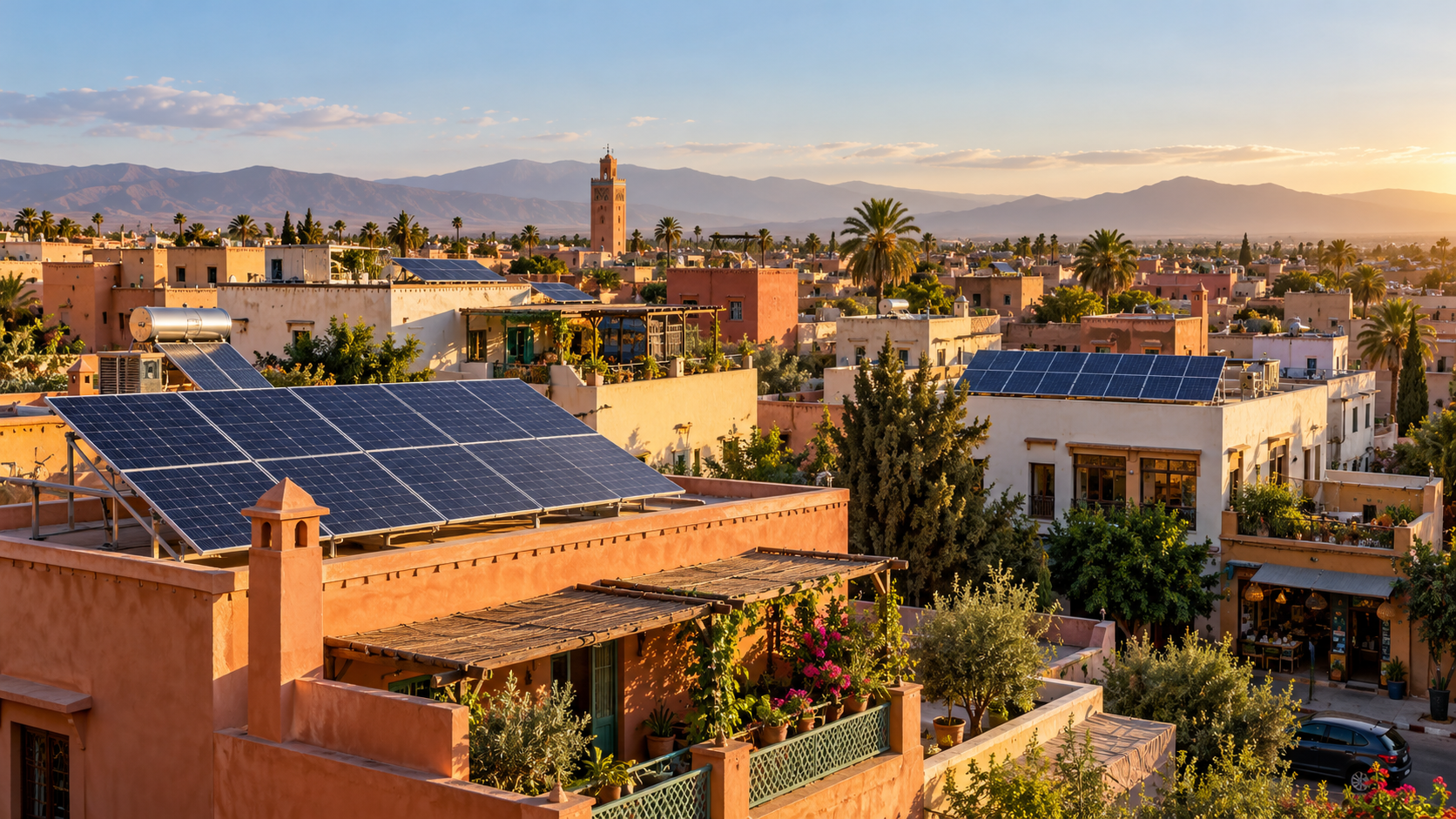
In our first article, we traced the gap between Morocco’s headline renewable capacity figures and the energy that actually reaches households and businesses. We noted that while renewables accounted for 46.1% of installed electricity capacity by the end of 2025, the share in actual production remained far lower, and that grid saturation in the south was leaving some clean energy stranded. We also flagged a question that deserves closer attention: Could decentralized systems - rooftop solar, self-consumption, and citizen participation - offer a way around the bottlenecks of the centralized model?
That question now has a clearer answer. As of June 2026, Morocco’s legal framework for self-generation is finally operational. The regulatory gates have opened. What remains to be seen is whether households and businesses will walk through them.
The Regulatory Breakthrough: Law 82.21 Comes to Life
For years, Morocco’s self-generation law - Law 82.21, adopted in February 2023 - existed on paper, but lacked the implementing decrees needed to make it functional. That changed on March 5 2026, when Decree No. 2.25.100 was published, entering into force on 9 June 2026.
The decree establishes a three-tier system based on installed capacity:
- Declaration scheme for installations under 11 kilowatts, requiring only a simple declaration;
- Connection approval scheme for installations between 11 kilowatts and 5 megawatts;
- Authorization scheme for installations of 5 megawatts or more connected to medium, high, or extra-high voltage grids.
Processing times are now regulated: Construction approval must be issued within 30 days of a complete application, and the mandatory technical study by the grid operator must be completed within three months, extendable by 30 days. Construction must be completed within two years of signing the connection agreement, with a possible one-year extension under exceptional circumstances.
Crucially, the framework also addresses compensation for surplus energy. ANRE Decision No. 04/26 sets the feed-in tariff for surplus electricity sold back to the grid - capped at 20% of annual production—at 18 centimes per kWh during off-peak hours and 21 centimes during peak hours. This is not a lavish rate, but it provides a degree of certainty that did not exist before.
For existing installations, Article 33 of Law 82.21 establishes a transitional compliance regime. Operators of pre-existing self-generation facilities must now assess which scheme applies to them and take the necessary steps to comply.
Why Rooftops Matter More Than Ever
The regulatory opening coincides with a growing body of evidence that Morocco’s rooftop potential is far larger than previously understood.
A 2025 study by the IMAL Initiative for Climate and Development modelled three scenarios for distributed renewable energy systems by 2035. The median scenario projects 40.1 TWh of electricity generated from rooftops, 17.15 GW of installed capacity, a market worth USD 18.65 billion, and 28.91 million tonnes of CO₂ avoided. The optimistic scenario reaches 66.8 TWh, 28.58 GW, and a market of USD 31.08 billion.
These are not marginal figures. The median scenario alone would represent more installed capacity than Morocco’s entire current renewable fleet.
A separate IEEE study, presented in Marrakech in December 2025, used 3D digital surface models and irradiance modelling across five Moroccan cities—Agadir, Casablanca, Ouarzazate, Oujda, and Tétouan. The findings confirmed that most rooftops receive more than 1,250 kWh/m² annually, with significant fractions exceeding 1,500 kWh/m². The study also noted a critical gap: Morocco lacks a national solar cadastre, meaning spatial planning for distributed PV remains fragmented.
The Storage Multiplier: EVs as Mobile Batteries
The IMAL report introduces a dimension that is often overlooked in discussions of household energy: The synergy between rooftop solar and electric mobility.
By 2035, Morocco is projected to have approximately 2.5 million electric vehicles in circulation. If these vehicles are equipped with bidirectional charging capabilities - enabling Vehicle-to-Grid (V2G) and Vehicle-to-Home (V2H) functionality - they would collectively represent a mobile storage capacity of roughly 39,420 GWh, equivalent to 91% of the country’s projected electricity demand for 2035.
This is not a speculative fantasy. Bidirectional charging technology is maturing rapidly, and the combination of rooftop solar plus EV storage could allow households to shift from passive consumers to active participants in grid management - charging when solar production is high and discharging during peak demand or outages.
The IMAL analysis suggests that rooftop solar in the median and optimistic scenarios could cover 59% to 98% of the charging demand for this EV fleet. The implication is clear: the same rooftops that could reduce household electricity bills could also power the country’s transport transition.
The Job Creation Dimension
Decentralized energy is often discussed in technical terms - kilowatts, tariffs, grid codes, but the socioeconomic implications are equally significant.
Preliminary estimates from the IMAL report suggest that developing Morocco’s DRES market could create between 13,000 and 43,000 jobs over the next decade in project development and installation alone. These are local jobs - rooftop assessments, system design, electrical work, maintenance - that cannot be outsourced to distant mega-projects.
For a country with persistently high youth unemployment, this matters. The transition from large-scale, capital-intensive projects to distributed, labor-intensive deployment changes the economic calculus of the energy transition.
The Tensions That Remain
The regulatory framework is now in place. The technical potential is documented. The economic case is strengthening. But several tensions remain unresolved.
First, the feed-in tariff is modest. At 18–21 centimes per kWh, the compensation for surplus energy is unlikely to drive rapid adoption on its own. The primary economic driver for households will be avoided consumption - using self-generated electricity to reduce grid purchases, particularly during peak tariff periods. This favors systems sized for self-consumption rather than export maximization.
Second, the technical study requirement adds cost and time. For installations between 11 kW and 5 MW, the grid operator must conduct a technical study at the applicant’s expense, with a timeline of up to three and a half months. For small businesses and cooperatives, this represents a meaningful barrier.
Third, awareness and financing remain obstacles. The IMAL report notes that Morocco’s New Development Model explicitly endorses decentralized generation as a means to “strengthen the reliability, resilience, balance, and competitiveness of the energy system”. However, policy endorsement does not automatically translate into household adoption. Access to credit, trustworthy installers, and clear information about costs and benefits will determine whether the framework is actually used.
Fourth, the grid must adapt. A system with millions of small-scale producers requires different grid management than one dominated by centralized plants. Bidirectional flows, voltage regulation, and data exchange all become more complex. ONEE’s MAD 248 Billion investment plan for 2026–2030 includes 2.6 GW of energy storage and significant transmission upgrades, but the distribution-level infrastructure that connects rooftops to the grid may require separate attention.
What This Means for Households and Businesses
The practical implications for a Moroccan household considering rooftop solar are now clearer than they were a year ago. In fact, a typical residential system under 11 kW falls under the declaration scheme - a simple administrative step, not a full approval process. The investment case rests primarily on avoided electricity purchases, with surplus export as a secondary benefit. For a household in Ouarzazate or Marrakech, where summer cooling loads are high and irradiance is excellent, the payback period could be attractive, particularly if financing is available.
For a small business - a workshop, a cold storage facility, a hotel—the calculus is more complex. A system between 11 kW and 5 MW requires connection approval and a paid technical study. Nevertheless, for businesses with daytime loads that coincide with solar production, the combination of avoided consumption and surplus export at 21 centimes during peak hours may justify the investment.
For larger industrial consumers, the authorization scheme for installations above 5 MW offers a path to significant self-generation, reducing exposure to grid tariffs and improving competitiveness.
The Broader Picture: Democratizing Energy
In a speech at the Assilah forum in October 2026, former Spanish Foreign Minister Miguel Ángel Moratinos invoked the concept of “energy democratization,” arguing that technological development will enable individuals to produce part of their own energy needs, much as smartphones transformed telecommunications. The analogy is imperfect - electricity is not information, and grid physics impose constraints that data networks do not - but the direction of travel is real.
Until now, Morocco’s energy transition has been defined by large-scale projects: Noor Ouarzazate, Tarfaya wind, the green hydrogen consortia in the southern provinces. These projects will remain essential; but the next phase of the transition will be measured not only in gigawatts of centralized capacity, but in the number of rooftops, businesses, and communities that become active participants in the energy system.
The regulatory framework is in place. The potential is documented. The question now is whether the incentives, financing, and practical support will be sufficient to turn a legal opening into a material transformation.
This is the second in a series of articles exploring Morocco’s energy transition. Previous articles can be found on our blog. Next month, we will be analyzing the role of green hydrogen in Morocco’s industrial strategy.