.png)
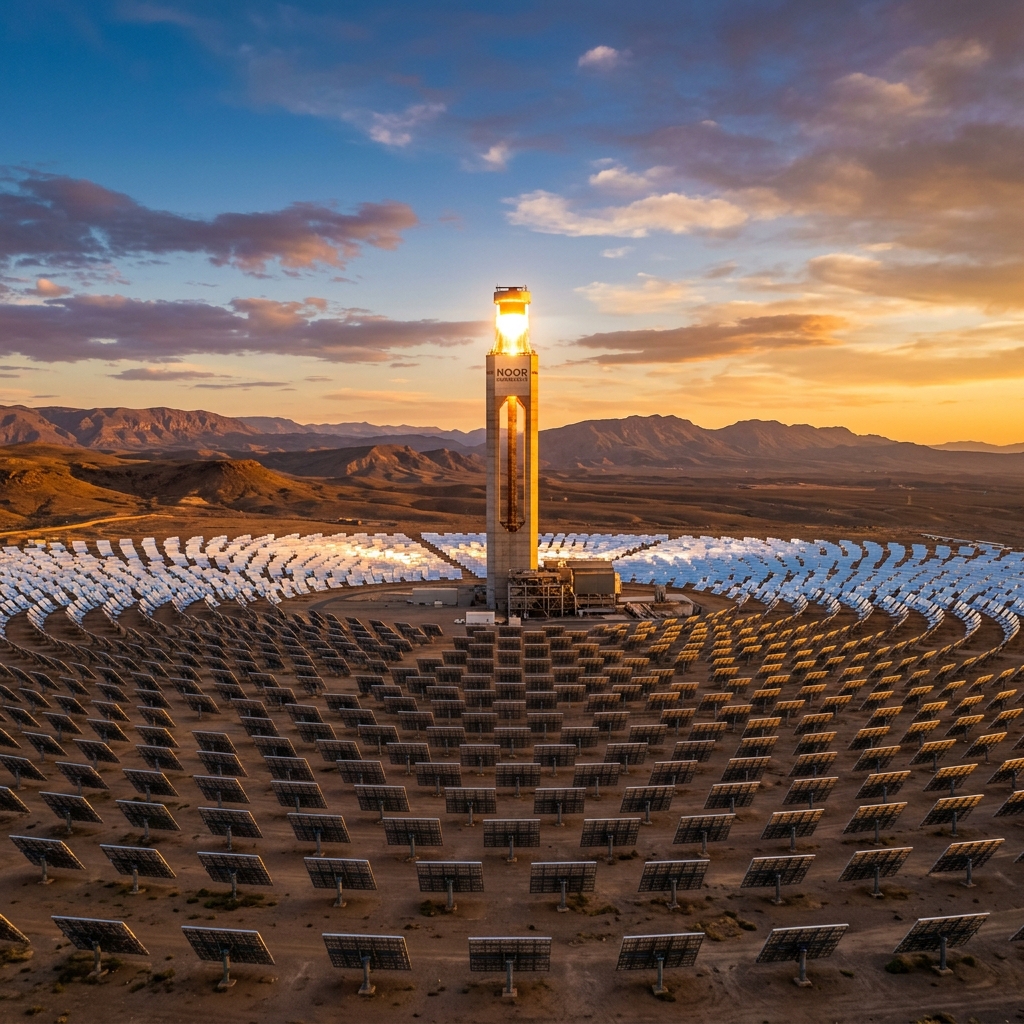
When we talk about Morocco’s energy transition & sustainability, the numbers that usually make the headlines are impressive. The government points to 46% of installed renewable electricity capacity—a figure that places Morocco among Africa’s leaders. The Noor Ouarzazate Solar Complex, with its towering 247-metre central receiver, stands as a global symbol of clean energy ambition.
But here’s the tension that defines Morocco’s energy reality today: installed capacity is not the same as actual production.
In 2022, Morocco generated nearly 43 terawatt-hours of electricity, but grid inefficiencies meant only about 38 TWh reached end users. And despite the visible expansion of solar and wind farms, fossil fuels still generated 83% of electricity in 2022, with coal alone accounting for nearly 60% of the mix as recently as 2024. At the end of the chain, when measured against everything Moroccans consume, from the diesel in cars to the butane in kitchens, renewables represent barely 4% of total national energy consumption.
This gap between ambition and delivery is the starting point for understanding what the energy transition & sustainability in Morocco really means for its economy, its households, and its industries.
A Strategy Built on Three Pillars
Morocco’s national energy strategy, launched in 2009, rests on three foundations: Expanding renewable capacity, improving energy efficiency & sustainability by 20% by 2030, and strengthening regional integration through electricity interconnections with Europe and sub-Saharan Africa.
From this perspective, the country has set targets that remain ambitious by any global standard: 52% renewable electricity capacity by 2030, revised upward to 56% by 2027, and a conditional commitment to phase out coal power entirely by 2040. A $12 billion investment program for 2025–2030 is currently rolling out, with plans to build nearly 16 GW of new generation capacity, 80% of which will come from renewables.
Why Are Renewables Still Falling Short in Practice?
The central challenge is integration. Morocco has built the big projects, but the grid that connects them to homes and businesses has not kept pace.
The transmission line connecting the southern provinces, where much of the new wind and solar capacity is located, is already saturated. Until new high-voltage lines come online, some of that clean energy will remain stranded.
There are also deeper structural issues. The government's own climate performance evaluation flags significant implementation gaps: building efficiency standards exist; yet, they lack resources for monitoring; energy-intensive appliances remain widely available; and the pace of solar and wind development has been slowed by technology disputes and tendering delays.
Perhaps the most critical barrier is financial. Experts estimate that attracting an additional US$1–2 billion in private investment will be essential to accelerate the next phase of Morocco’s energy transition & sustainability.
The Fossil Fuel Anchor
Behind the renewable push, Morocco’s energy system remains anchored to imported fossil fuels. Nearly 90% of the country’s energy supply comes from abroad, making the economy vulnerable to global price shocks.
Coal still provides the baseload power that keeps the grid stable. But fossil fuels extend far beyond electricity: diesel fuels transport, heavy fuel oil powers industry, and butane gas heats homes and runs kitchens. These are the fuels that households and businesses actually depend on, and they are precisely the hardest to replace.
This dependence is not merely technical; it is also political and economic. Petroleum subsidies remain politically sensitive, and the government has struggled to remove them given the widespread use of gas among Moroccan households.
Where Is the Transition Actually Happening?
Despite these constraints, momentum is building in several areas.
In the southern provinces, large-scale projects are proliferating. By the end of 2024, these regions accounted for about 25% of Morocco’s installed renewable capacity, with over 1.3 GW operational and another 1.4 GW planned by 2027. The Tarfaya wind farm, with 131 turbines and 300 MW capacity, already powers the equivalent of 1.5 million households.
On the horizon, green hydrogen is attracting serious investment. Seven international consortia have been selected to develop projects across the southern provinces, with total capacity expected to reach 10 GW of electrolysers and produce green ammonia, synthetic fuels, and green steel for export markets. The Chbika project near Guelmim, led by TotalEnergies, aims to produce 200,000 tonnes of green ammonia annually using solar and wind power combined with desalinated seawater.
In the electricity sector, wind and solar supplied nearly 25% of the nation’s electricity in 2024, up from just 9% in 2015. The coal share has begun to decline, dropping from 70% in 2022 to 59% in 2024.
What This Means for Households and Businesses
The transition is not abstract. For Moroccan households, it shows up in electricity bills that already consume a significant share of income; some families in Ouarzazate, for instance, spend roughly a fifth of the average monthly income on electricity in the summer, where air conditioning is a necessity.
For businesses, the cost of energy, and uncertainty about future prices and supply affects competitiveness. The shift toward local renewable production offers the promise of more stable energy costs, but only if Morocco can overcome the grid and integration challenges that currently stand in the way.
The Decentralisation Opportunity
One emerging alternative could reshape how Moroccans participate in the transition. Experts and civil society groups are increasingly calling for a shift toward decentralised renewable energy: rooftop solar panels, local microgrids, and community-owned systems that allow households and businesses to produce their own electricity.
A recent report by the IMAL Initiative for Climate and Development estimates that Morocco's rooftops could generate between 20 and 67 TWh of clean electricity by 2035, equivalent to an installed capacity of 8.6 to 28.6 GW and a potential market worth up to $31 billion. Such systems could create between 13,000 and 43,000 jobs over the next decade, while reducing pressure on the central grid and strengthening resilience.
Yet, regulatory barriers remain. The legal framework for self-production, law 82.21, has seen its implementing decrees delayed, creating uncertainty that holds back investment. To date, three key implementing decrees (2.25.100, 2.24.804, 2.24.761) are in effect, but several supplementary texts regarding authorization procedures and technical connection conditions; the terms of selling excess electricity to grid operators; and finally, regarding energy storage services provided for by the law, are still being developed to cover all the provisions of law 82.21.
Looking Ahead
Morocco is at a pivotal moment. The country has demonstrated that it can build world-class renewable infrastructure. But the transition from capacity to actual clean energy consumption requires a more complex set of changes: grid modernisation, regulatory reform, clearer technology choices, and greater citizen participation.
The question is no longer whether Morocco can build large solar plants. It is whether the country can redesign its energy system so that ordinary Moroccans, businesses, and industries can access and benefit from the clean energy being produced.
Over the coming months, this blog will explore how researchers, industry, and policymakers are working to close that gap, and what it will take to make Morocco’s energy transition & sustainability a reality for everyone.
This is the first in a series of articles exploring Morocco's energy transition & sustainability. The second article, on decentralised energy systems and household participation, will be published on September 15.